


For the first time since the pandemic recovery began, we're witnessing a fundamental transformation in how global talent moves—and it's raising critical questions for every organization with international operations.
The Numbers Tell a Striking Story
Boston Consulting Group's latest analysis reveals an 8.5% decline in international movement among highly skilled workers, marking the first significant slowdown since 2020. This isn't just a statistical blip—it represents a fundamental shift in the global talent landscape that mobility professionals and corporate leaders need to understand and prepare for.
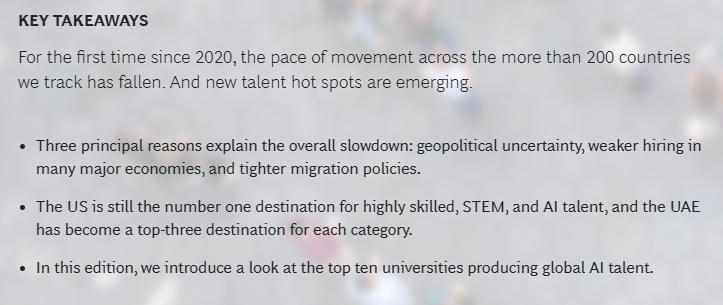
The data becomes even more revealing when we examine where talent is flowing. While the United States maintains its position as the primary destination for STEM and AI professionals, the competition for top talent has intensified dramatically. Emerging powerhouses like the UAE and Saudi Arabia are no longer peripheral players—they're becoming serious contenders in the global talent race, offering compelling packages and building innovative ecosystems designed to attract the world's best minds.
The Forces Reshaping Talent Flows
Several converging factors are driving this transformation. Geopolitical uncertainty continues to influence both corporate expansion decisions and individual career choices. Economic headwinds in traditional destination markets are causing organizations to reconsider their talent strategies, while employees weigh the risk-reward calculus of international moves more carefully than ever.
Migration policy has also become a major friction point. Canada and the United Kingdom—historically two of the most welcoming destinations for skilled talent—have implemented substantial tightening measures that are fundamentally changing mobility patterns. These policy shifts don't just affect volume; they're forcing organizations to completely rethink their talent sourcing and deployment strategies.
The situation in Germany exemplifies the challenge facing many developed economies. Once considered a beacon for skilled professionals, Germany now experiences net outflows of talent—more highly skilled workers are leaving than arriving. This reversal signals how quickly competitive positions can shift in the global talent marketplace.
New Talent Hubs Are Emerging
While traditional talent magnets face headwinds, new patterns are emerging that forward-thinking organizations are already leveraging. India's universities have established themselves as the dominant launchpads for globally mobile AI talent, producing graduates who are reshaping technology teams worldwide. Companies that build strong recruiting relationships with these institutions gain significant competitive advantage in accessing emerging AI expertise.
The rise of Gulf nations as talent destinations represents more than just increased compensation packages. These countries are investing heavily in research infrastructure, creating innovation zones, and developing quality-of-life amenities that make them increasingly attractive to professionals who might have previously only considered North American or European opportunities.
Critical Questions for Corporate Leaders
This shifting landscape demands honest assessment from every organization competing for global talent:
Is your Employee Value Proposition (EVP) competitive in today's market? Generic benefits packages and standard relocation support no longer differentiate you when professionals can choose between opportunities across continents. Your EVP must specifically address why top talent—particularly in digital transformation and GenAI fields—should choose your organization over compelling alternatives in emerging markets offering tax advantages, lower living costs, and accelerated career growth.
Does your talent strategy account for the new geography of innovation? If your recruitment and mobility programs still focus exclusively on traditional markets, you're missing the talent pools that will define the next decade of competitive advantage. Organizations that successfully tap into emerging talent hubs while navigating complex immigration landscapes will outperform those stuck in legacy patterns.
Are you prepared for continued policy volatility? The immigration policy environment will likely remain unpredictable, with changes happening at both national and regional levels. Your mobility program needs the agility to pivot quickly—whether that means establishing new regional hubs, leveraging remote work arrangements, or developing alternative pathways for talent access.
Will your organization be a winner or a watcher? The talent competition isn't over—it's intensifying and becoming more geographically distributed. Companies that recognize this shift early and adapt their strategies accordingly will secure the human capital needed for innovation and growth. Those that maintain status quo approaches risk finding themselves on the outside looking in.
The Mobility Professional's Perspective
For those of us in global mobility and relocation services, this transformation creates both challenges and opportunities. Our corporate clients are asking harder questions about ROI on international assignments, seeking more flexible arrangements, and demanding strategic counsel beyond operational execution.
The most valuable conversations we're having with clients now focus on strategic workforce planning: How do we build talent pipelines that account for these new realities? What alternative models exist beyond traditional expatriate assignments? How do we balance talent needs against tightening immigration environments and economic pressures?
Global talent flows will continue shifting as immigration policies tighten in traditional markets and emerging hubs invest aggressively in attracting skilled professionals. Mobility programs built for the last decade's geography won't serve the next decade's needs. Early movers will secure the talent that shapes what comes next.

/Passle/56686a093d94740bd0dda608/SearchServiceImages/2026-09-28-14-19-05-543-6aba775957009c2a3813850c.jpg)
/Passle/56686a093d94740bd0dda608/SearchServiceImages/2026-10-05-19-37-55-698-6ac3fc939419104bcb84c3ed.jpg)
/Passle/56686a093d94740bd0dda608/SearchServiceImages/2026-09-01-12-52-55-677-6a96caa7f9386af8ea6f23d9.jpg)