


Fragomen's Worldwide Immigration Trends Report paints a picture of an immigration landscape fundamentally reshaped by geopolitical instability, economic realignment, and regulatory transformation. For mobility professionals, the message is clear: what once seemed like temporary disruptions have become permanent features of workforce planning.
The report identifies three interconnected challenges driving this shift. First, sourcing talent now requires navigating ongoing conflict zones, trade realignments, and the emergence of new business hubs across Southeast Asia, the Middle East, and Latin America. Crisis-related relocation requests have doubled over the past four years—a stark indicator that emergency response has become routine. Second, the economics of mobility are under pressure from rising relocation costs (averaging $77,000 per employee and exceeding $300,000 for long-term assignments), sharply increased government fees, and elevated salary thresholds in key destinations. Third, compliance demands continue to intensify as governments digitize immigration systems while simultaneously expanding employer obligations across the full assignment lifecycle.
Yet within these challenges, the report identifies meaningful opportunities for organizations willing to invest in strategic mobility capabilities.
Five Key Takeaways
1. Immigration strategy is now business strategy. The report emphasizes that mobility can no longer operate as a siloed administrative function. Organizations achieving the best outcomes are integrating immigration planning into broader corporate decisions about where to locate operations, how to structure R&D investments, and when to expand into new markets. This alignment ensures workforce deployment decisions account for immigration feasibility, processing timelines, and regulatory risk from the outset.
2. Geographic diversification is accelerating—and necessary. Companies are actively reducing concentration in traditional high-cost destinations like the U.S. and UK in favor of emerging talent hubs. Southeast Asia offers favorable tax structures and expanding technical workforces. Latin America, particularly Mexico and Brazil, is benefiting from nearshoring momentum. Central and Eastern Europe provides stable governance and EU market access. These aren't just cost plays—they're strategic moves to build resilience against regional disruptions.
3. Data-driven mobility planning delivers measurable advantages. The report notes that 95% of employers cannot currently measure ROI on international assignments, resulting in significant inefficiency. Organizations that quantify outcomes—retention rates, time-to-fill reductions, redeployment success—can demonstrate mobility's tangible value and make smarter allocation decisions. This analytical capability also supports crisis response by enabling rapid identification of redeployment options when disruptions occur.
4. Compliance complexity demands proactive investment. Government notification requirements, departure obligations, posted worker rules, and digital arrival card systems have expanded employer responsibilities well beyond visa sponsorship.
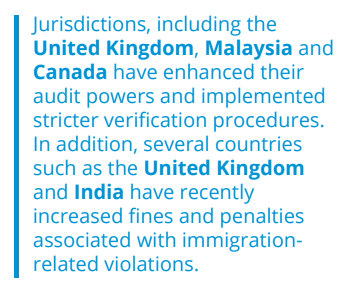
The report highlights that countries are simultaneously tightening requirements and digitizing processes—creating efficiency gains alongside new compliance risks. Organizations that treat compliance as a strategic function rather than an administrative burden will be better positioned to navigate this dual reality.
5. The Talent Mobility Index shows a tightening global environment. Fragomen's proprietary index increased from 42 to 44 in 2025 (higher scores indicate more restrictive policies), with over 110 countries implementing stricter measures. Processing times lengthened in more than 20 countries, and minimum salary thresholds rose in over 40 jurisdictions.
The Index provides a comparative score that helps companies and policymakers assess the ease of transferring or hiring foreign talent worldwide by offering a clear, data-driven benchmark of global immigration regulations.
However, the picture isn't uniformly negative—roughly 20 countries lowered barriers through processing improvements and eased nationality-specific restrictions. So it is a bit of a mixed bag and your experiences will be locationally based.
The organizations that will thrive are those treating immigration not as a cost center to minimize but as a strategic capability to develop. This means investing in technology for compliance tracking, building analytical capabilities to measure mobility outcomes, diversifying geographic footprints to reduce risk, and ensuring mobility teams are included when business leaders make decisions about global operations.
None of this is temporary. Organizations that invest in mobility capabilities now, whether in technology, analytics, or simply ensuring immigration has a voice in business planning, will outperform those still treating global workforce deployment as a back-office function.

/Passle/56686a093d94740bd0dda608/SearchServiceImages/2026-10-13-17-20-19-458-6ace6853ba4fc866bfdbb6e6.jpg)
/Passle/56686a093d94740bd0dda608/SearchServiceImages/2026-04-09-20-33-01-847-69d80cfda2453629156ee342.jpg)
/Passle/56686a093d94740bd0dda608/SearchServiceImages/2026-10-13-17-32-29-094-6ace6b2d477453bcaa2f0248.jpg)