


The debate over immigration's economic impact is rarely framed around corporate relocation — but maybe it should be.
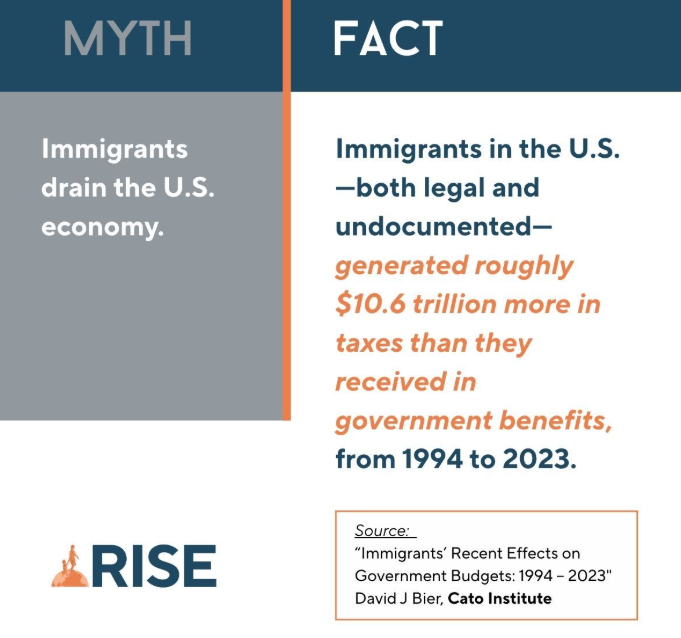
A sweeping new white paper from the Cato Institute offers the most comprehensive fiscal accounting of immigrants in the United States to date, and the numbers are hard to ignore. Covering the years 1994 through 2023, the analysis finds that immigrants generated a fiscal surplus of roughly $14.5 trillion — paying more in taxes than they received in government benefits at every level. Without those contributions, U.S. public debt would already exceed 200% of GDP — nearly double its 2023 level.
For global mobility professionals, the report is more than an immigration policy document. It's a data-rich lens on something we've long understood intuitively: when companies move talented people across borders, they aren't just solving a workforce problem. They're delivering real economic value to the countries and communities that receive them.
Mobility as Economic Infrastructure
Corporate assignees and internationally mobile employees represent a distinct profile within the broader immigrant population. They tend to arrive with established employment, above-average compensation, and — critically — immediate tax contributions. Immigrants contributed above their population weight in tax revenue, accounting for 17.3% of all tax revenue despite representing 14.7% of the population, while making up only 7% of government spending. Corporate transferees fit squarely within that pattern.
This matters for how mobility programs are framed, both internally and externally. When a company relocates a software engineer from Seoul to Austin, or a finance director from London to Singapore, that individual isn't a cost to the host economy — they're a fiscal contributor from day one.
A Counterweight to Demographic Headwinds
Many of the world's most popular corporate destination markets — the U.S., Germany, Canada, the UK, Japan — are grappling with the same underlying challenge: aging workforces, shrinking labor pools, and growing pressure on public pension and healthcare systems. Immigrants are disproportionately of prime working age, and fewer are in retirement, meaning fewer collect the large old-age benefit programs that dominate government spending.
Corporate mobility pipelines feed directly into this demographic gap. When a multinational fills a critical role with an internationally mobile employee, it's not just filling a seat — it's adding a prime-age taxpayer to an economy that needs them. The Cato analysis found that even immigrants without higher education generated net fiscal surpluses, and even the lowest-skilled cohort reduced the U.S. debt-to-GDP ratio. For skilled corporate transferees, the fiscal math is even more favorable.
The Multiplier Effect Companies Often Miss
There's a broader economic story that corporate mobility teams rarely get credit for surfacing. The Cato researchers note that their model represents a lower bound of immigration's positive fiscal effects, because it doesn't account for the indirect economic growth that immigrant workers generate. Innovation, knowledge transfer, entrepreneurship, spending in local housing markets, use of local services — none of that is fully captured in the fiscal model. But mobility professionals see those effects every day.
When a relocated employee rents or buys in a new city, enrolls children in schools, hires local service providers, and builds a professional network, the host community benefits across multiple dimensions. Corporate mobility programs are engines of that kind of embedded economic activity — distributed across destination cities and countries worldwide.
Framing the Value Conversation Differently
Global mobility has long struggled to communicate its strategic value in terms that resonate at the C-suite level. The conversation often gravitates to cost — cost per move, cost per assignment, cost compared to local hires. That's a frame that undersells what mobility actually does.
The Cato research offers something more useful than another data point in that internal debate. It reframes who the corporate transferee actually is in the eyes of the host economy: not a claimant on public resources, but a net contributor to them. Rather than burdening public finances, immigrants served as a fiscal stabilizer during a period marked by rising deficits and expanding public debt. Corporate assignees — skilled, employed, and tax-paying from day one — represent the most concentrated expression of that dynamic.
That reframe has practical implications for how mobility leaders talk to their stakeholders. For the CFO, it reinforces that relocating talent is deploying value-generating human capital, not subsidizing lifestyle logistics. For the CHRO, it strengthens the talent strategy narrative at the board level — global mobility isn't just filling seats, it's placing contributors. For the General Counsel or Government Affairs team, it's protective framing in an era of rising economic nationalism: our people contribute to the economies they enter; they don't extract from them. And for the CSO or sustainability function, a mobility program that demonstrably generates fiscal value in host markets is a social impact story hiding in plain sight — one that may belong in ESG reporting and employer brand conversations alike.
None of this replaces the internal ROI case. But mobility leaders who can connect their program's footprint to the broader economic contribution their transferees and assignees make — to host governments, local labor markets, and the tax bases that fund public services — are doing something most functions can't: making the business case and the citizenship case at the same time.
The Cato Institute's full white paper is available here. Thanks Richard Burke from Envoy Global for the interesting LinkedIn post!

/Passle/56686a093d94740bd0dda608/SearchServiceImages/2026-08-25-19-31-26-587-6a8ded8e7d0bbb1cefecaf47.jpg)
/Passle/56686a093d94740bd0dda608/SearchServiceImages/2026-08-17-14-51-44-833-6a832000113f582fe660a2e7.jpg)
/Passle/56686a093d94740bd0dda608/SearchServiceImages/2026-08-24-12-34-22-697-6a8c3a4e0752bb100bf9456c.jpg)