


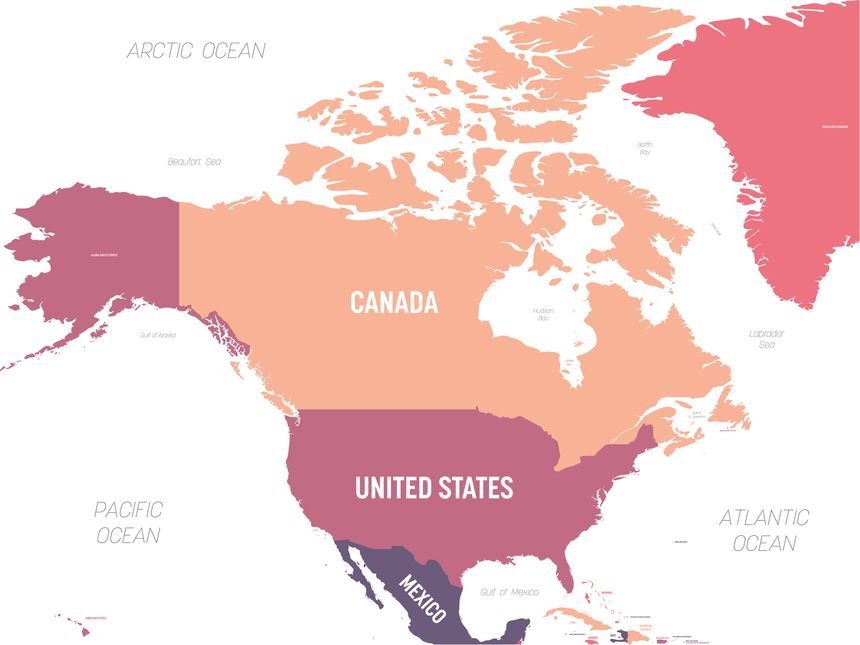
If your mobility program covers North America, the housing market is sending you three different signals right now, and they're pointing in three different directions. Canada is in a historic correction. The U.S. is softening unevenly, having lived through years of rental inflation that your employees still feel acutely. And Mexico is tightening. Understanding all three is no longer optional for programs that want to stay ahead of cost and employee experience.
United States: Relief Is Real — But So Is the Accumulated Damage
The national headline is modestly encouraging. National median rent ticked up slightly to $1,363 in April 2026, the second consecutive monthly increase, but rents remain down roughly 1.7% year-over-year... The national vacancy index stands at 7.3%, the highest since tracking began, reflecting a market where landlords face real competition for tenants.
The city-level picture is where it gets interesting. Austin has seen the nation's sharpest decline among large metros: down 6% over the past year and more than 20% from its 2022 peak, driven by the fastest pace of new multifamily permitting of any large metro in the country. San Antonio, New Orleans, and Denver each fell roughly 5%, while Phoenix, Tampa, and Salt Lake City posted declines of 4%, 4%, and 2% respectively. Among the ten metros with the sharpest year-over-year rent declines, nearly all are in the Sun Belt, and most also rank among the highest in new multifamily construction permits.
On the other side of the ledger, rental markets are tighter in the Midwest, Northeast, and parts of the West Coast, markets where building is harder due to zoning constraints and limited land supply. Median rent was up around 5% in Virginia Beach and the Bay Area, 4% in Chicago, and 3% in St. Louis.
But here's the context that matters most for mobility programs: even where rents have "declined," they remain dramatically higher than pre-pandemic baselines. We covered this in detail in our recent post What, Rent Is How Much? A Six-Year Look at U.S. Rental Inflation, but the key takeaway bears repeating: average rents across 30 major U.S. cities have surged 36% since 2020, with Sun Belt metros running far higher. Miami is up 53%, Tampa 50%, Riverside 48%, St. Louis 44%. A 4–6% pullback from peak is meaningful relief, but it doesn't erase a 50% run-up. COLA and housing assistance benchmarks tied to pre-2020 baselines are significantly understating current burden across nearly every U.S. market.
AIRINC's latest North American update flags Atlanta, Dallas, Denver, Raleigh, San Diego, Seattle, and Bellingham among the markets seeing the steepest home purchase price declines, cities where both the for-sale and rental markets are cooling simultaneously, with direct implications for home sale programs.
Canada: A Correction Without Modern Precedent — and a Purchase Market With Real Constraints
The story in Canada moves in the opposite direction from the accumulated U.S. inflation picture. Average asking rents in Canada fell to $2,008 in March 2026, a 35-month low. Rents are down 5.3% year-over-year, the largest annual decline in nearly five years, and have now fallen for 18 consecutive months. Measured from the peak, rents are down approximately $194, or 8.8%, since May 2024.
The correction is uneven by property type: condos fell 6.9%, houses and townhomes dropped 9.0%, and purpose-built rentals saw smaller declines of 3.9%. Studio units in the condo market fell more than 10% year-over-year. Major provinces are broadly aligned (Ontario, British Columbia, Alberta, and Quebec all posted year-over-year declines) while Nova Scotia (+3.3%), Saskatchewan (+2.7%), and Manitoba (+2.1%) continue to see upward pressure.
The supply-side story is real: new construction and more condo units entering the rental market have added inventory. But the more consequential driver is deliberate immigration policy. In what CMHC describes as a historic first, the Canadian government has proactively used immigration reductions to address housing affordability, directly linking population growth management to shelter costs. The result: Canada's population actually declined in 2025 for the first time since Confederation, with Ontario and British Columbia seeing their populations fall outright for the first time on record. TD Economics notes the purpose-built rental market has been particularly affected, with rent growth forecasts running roughly half the rate seen in 2024.
For mobility programs, the rental correction is welcome news for allowance benchmarks. But it doesn't resolve the more complex issue on the home purchase side. Canada's Prohibition on the Purchase of Residential Property by Non-Canadians Act, which took effect in 2023 and was extended through January 1, 2027, continues to shape how inbound mobility programs are structured. The practical picture, informed by our Canadian partners on the ground, is nuanced. Most transferees entering on valid work permits with 183 or more days of remaining validity are exempt and can purchase, and in practice, this is where the majority of typical relocation scenarios land. Where the ban remains a genuine constraint is in corporate home sale program design. Non-Canadian companies and non-Canadian RMCs cannot participate in BVO or GBO transactions in affected markets, which covers most of Southern Ontario, including Toronto, Hamilton, London, and Kitchener, as well as most other major Canadian metros. Canadian subsidiaries of foreign-headquartered companies are similarly restricted. What this means operationally is that programs that would otherwise offer employer-backed home sale benefits are still largely relying on rental-first strategies, direct reimbursement of closing costs, or extended benefit timelines that bridge to when the ban expires. Any program sending employees into or out of Canada should have a clear eligibility verification step built in, ensuring both the employee and any service partners understand where the lines are.
Mexico: The Countertrend
While Canada corrects and the U.S. digests its post-pandemic hangover, Mexico is running a different script entirely. Mexico's rental market is growing at around 5% year-over-year in 2026, outpacing the general inflation rate of 3.5%, meaning rents are rising in real terms. In the key business centers most relevant to corporate mobility, the pressure is sharper: Mexico City's prime neighborhoods (Reforma, Roma, Polanco, Condesa) are tracking toward average rents above US$1,100/month, driven by high demand and rising construction costs.
The vacancy rate in Mexico's desirable urban neighborhoods sits between 4% and 7%, indicating a tight market where well-priced units typically move within 15 to 35 days. Monterrey's San Pedro Garza García district, a hub for multinational corporate operations, commands some of Mexico's highest 2-bedroom rents at MXN 28,000 to 55,000 per month. The near-term outlook offers little relief: high-demand areas like central Mexico City and San Pedro could see increases of 6% to 10% for the full year, sustained by the continued gap between home prices and household incomes, job clustering in major metros, and ongoing demand from expats and remote workers.
For programs sending talent to Mexico, housing budgets that haven't been revisited since 2023 are likely falling short, particularly given two consecutive years of above-inflation rent growth in the markets where most assignees actually land.
What This Means for Your Program
Three countries, three divergent trajectories, and three distinct action items:
In the U.S., the softening in Sun Belt markets creates an opportunity to recalibrate rental allowances downward in oversupplied metros. But don't let modest year-over-year declines obscure the six-year accumulation: COLA and housing benchmarks built on pre-2022 data are still understating real burden for transferees in most markets.
In Canada, this is a genuine buyer's (and renter's) moment. Benchmark review is overdue, and for once, the recalibration should lower costs.
In Mexico, the inverse problem applies. Programs that haven't revisited housing allowances recently are likely sending employees into markets where the gap between policy and reality is growing.
The North American housing market in 2026 is three stories running simultaneously. The programs that treat them as one are building policy around an average that reflects none of them.
/Passle/56686a093d94740bd0dda608/SearchServiceImages/2026-04-09-20-33-01-847-69d80cfda2453629156ee342.jpg)
/Passle/56686a093d94740bd0dda608/SearchServiceImages/2026-10-13-17-32-29-094-6ace6b2d477453bcaa2f0248.jpg)
/Passle/56686a093d94740bd0dda608/SearchServiceImages/2026-09-28-14-19-05-543-6aba775957009c2a3813850c.jpg)