


If you manage a globally mobile workforce, Envoy Global's freshly released 11th annual U.S. Corporate Immigration Trends Report is worth your time. Drawing on responses from more than 500 HR and global mobility professionals, the report paints a clear picture of an immigration system under significant stress, and of employers adapting in ways that have direct implications for relocation and mobility program design.
Here's what stood out.
Processing delays are the new normal, and they're affecting everyone
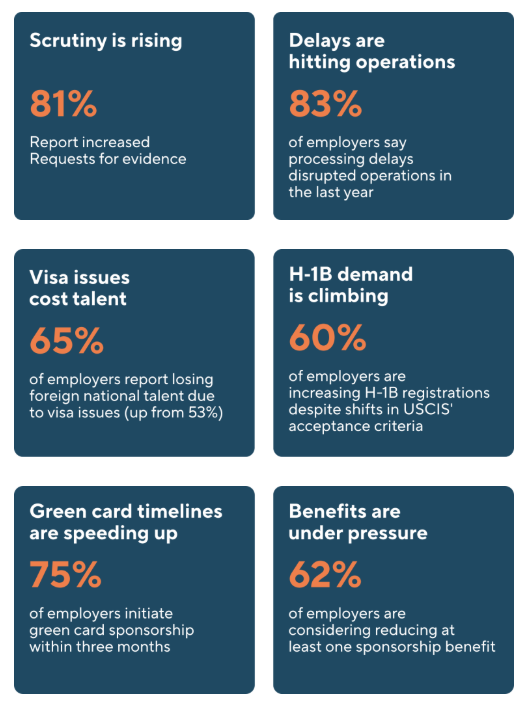
Eighty-three percent of employers report visa processing challenges, underscoring that delays are no longer an edge case. RFE (Request for Evidence) issuances have surged, and case timelines have become far less predictable. For mobility teams, the impact reaches past immigration operations. It cascades directly into start dates, lease commitments, school enrollment windows, and household goods logistics. When an employee's work authorization is in limbo, the entire relocation is in limbo.
H-1B demand is rising even as acceptance rates fall
Nearly six in ten employers increased their H-1B registrations year over year, even as USCIS accepted fewer overall. The gap between employer demand and available visa slots continues to widen. For many companies, this means a growing number of employees either cycle out of the U.S. or must be placed on alternative pathways. Mobility teams need to be ready for both scenarios.
Reentry delays are becoming a foreseeable operational risk
One of the report's more striking findings involves what happens when employees leave the U.S. for routine, compliance-driven reasons (visa stamping, family visits, business travel) and encounter unexpected delays getting back in. In 2026, consular appointment availability varies by region, additional vetting procedures are more common, and processing times can shift with little notice. The most common employer response? Allowing employees to use accrued paid time off (67.4%) is often the least disruptive and most cost-effective option, helping employers retain institutional knowledge and maintain project stability. The report frames this not as an emergency response but as a standard operating procedure, treating reentry disruptions as foreseeable events that require proactive planning rather than reactive scrambling.
Talent redistribution is accelerating
When U.S. immigration pathways narrow, companies act. Visa barriers are pushing companies to relocate critical talent to markets like Canada, Mexico, and the U.K. Financial and professional services, along with technology, report the strongest pivot toward global redistribution. These are sectors with heavy H-1B populations that can't afford to leave key roles unfilled. For global mobility functions, this is both a challenge and an opportunity: nearshoring and international transfers require the same infrastructure (destination services, tax support, policy frameworks) as traditional inbound assignments.
Costs are climbing, and programs are being restructured around them
Rising fees, shifting policies, and growing uncertainty are driving employers to rely on H-1B premium processing at record levels, adding significant per-case costs to immigration budgets that were already under pressure. The new $100,000 H-1B consular fee has introduced a new tier of cost calculus that HR and mobility leaders are now incorporating into program planning. Budget reallocation is the dominant theme.
Employers are consolidating providers and demanding better technology
More than half of employers plan to switch immigration providers to secure better technology and hybrid support models. With 98% of organizations now working with at least one immigration service provider, external support has become a central part of managing immigration programs. The appetite for consolidated, tech-enabled service relationships mirrors trends we're seeing across broader mobility program management. There's a preference for integrated partners over fragmented vendor rosters.
What this means for mobility teams
Immigration and relocation are more tightly linked than they've ever been. When visa timelines slip, move timelines slip. When talent gets rerouted to Canada or the UK, your domestic relocation playbook has to flex to accommodate an international move instead. When reentry becomes uncertain, temporary housing and lease flexibility matter more.
The Envoy Global findings are a reminder that immigration volatility isn't a legal department problem, it's a workforce strategy problem that requires coordinated responses across immigration counsel, HR, mobility, and talent acquisition. Teams that are proactively scenario-planning, benchmarking their programs, and building flexibility into policy design will be better positioned to absorb the disruptions that are now simply part of the landscape.
You can download the full 2026 U.S. Corporate Immigration Trends Report at envoyglobal.com.
/Passle/56686a093d94740bd0dda608/SearchServiceImages/2026-08-27-16-37-19-455-6a9067bf04144049273e38a0.jpg)
/Passle/56686a093d94740bd0dda608/SearchServiceImages/2026-09-11-12-43-14-097-6aa3f7624a3804d2c5d87e56.jpg)
/Passle/56686a093d94740bd0dda608/SearchServiceImages/2026-08-25-19-31-26-587-6a8ded8e7d0bbb1cefecaf47.jpg)