


Global talent mobility from July 9–22, 2026, is defined by tightening sovereign borders, digital visa modernization in Europe, and U.S. regulatory shifts. Multinationals are adapting to a cooling international talent pipeline by expanding distributed workforce models and utilizing agile tax-compliance platforms.
Global mobility is being reshaped by sweeping U.S. regulatory crackdowns and global diversification trends. The U.S. eliminated the "duration of status" rule for F, J, and I visas, revived the "public charge" rule, and continued to face immense visa backlogs. Globally, countries are pushing forward with localized hubs and frameworks like the EU Talent Pool. Let's look at some of the latest happenings around the world:
United States
- U.S. Citizenship and Immigration Services (USCIS) has announced that it has received sufficient H-1B petitions to meet both the regular H-1B cap and the advanced degree exemption for Fiscal Year (FY) 2027. According to USCIS, the agency received enough filings to reach the 65,000 regular H-1B cap established by Congress and the 20,000 U.S. advanced degree exemption, commonly referred to as the “master's cap”.
- The Department of Homeland Security (DHS) has finalized a significant regulatory change affecting international students and exchange visitors by ending the longstanding “duration of status” (D/S) framework for several nonimmigrant classifications. The rule represents one of the most consequential changes to the student visa system in decades and is expected to affect more than one million international students studying in the United States. Learn more regarding the implementation timeline and its impact on new entrants and F, J and I nonimmigrants already admitted to the United States in this webinar.
- The U.S. Department of State (DOS) has expanded its immigrant visa (IV) interview location policy, making country-of-residence processing the standard worldwide for most immigrant visa applicants.
- The California Department of Motor Vehicles (DMV) has announced that approximately 11,000 drivers are being required to retake their written knowledge test due to identified "irregularities" in test results. The issue affects individuals who took and passed their California driver's license knowledge exam between July 2025 and April 2026. This would include those who have relocated domestically or internationally to California during that timeframe. If you have an employee who obtained a California driver's license during this timeframe, we recommend reminding them to watch for official communication from the California DMV and to respond promptly if they receive a notice.
- The State Department is considering imposing a bond for certain visa applicants, adding to the Trump Administration’s efforts to sharply restrict immigration. The Wall Street Journal reported, citing people familiar with the plans, that the discussions have focused on placing a bond amounting to $100,000 on some green-card applicants.
- The August 2026 Visa Bulletin shows only modest forward movement (EB-2/EB-3 China, EB-3 Worldwide), while India's EB-2 category has gone unavailable for the rest of FY 2026 and EB-1 India is at risk of becoming unavailable soon amid high demand across employment-based categories. USCIS hasn't yet said whether it will accept August adjustment-of-status filings under Chart A or Chart B, so pending/upcoming India and China filers should watch for updates closely.
The European Union
- The EU Talent Pool is an important element of the EU's efforts to attract talent and address labor shortages, while facilitating legal pathways for migration, contributing to the EU's competitiveness. It will be the first EU-wide platform to facilitate the international recruitment of jobseekers residing outside the EU, while helping employers identify and recruit talent for occupations facing labor shortages within the EU. The EU Talent Pool platform is expected to be fully operational by the end of 2027.
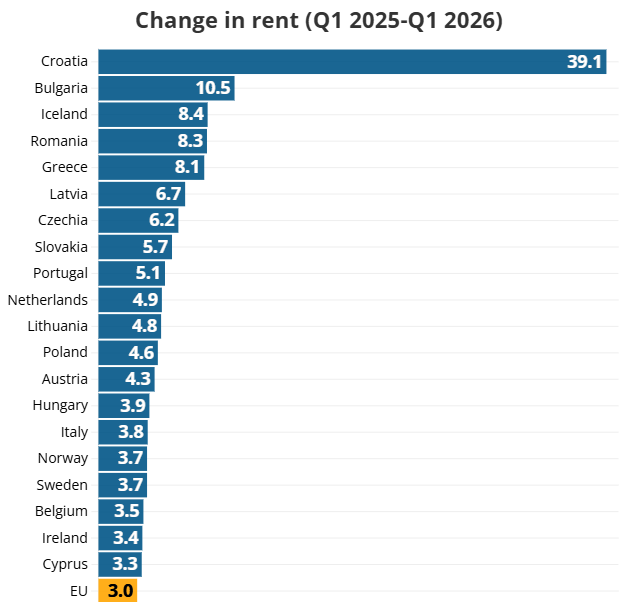
- In the first quarter of 2026, house prices in the EU rose by 5.1% and rents increased by 3.0% compared with a year earlier. Both outpaced the EU inflation rate of 2.3%, although the pace of growth varied widely across Europe, according to Eurostat. Among the 28 European countries with available data, covering EU countries except Greece, plus Norway and Iceland, house prices rose in all but Finland, where they fell by 2% between the first quarters of 2025 and 2026. Portugal saw the highest increase at 17.8%, followed closely by Bulgaria (14.8%), Slovakia (14.4%) and Croatia (14.3%).
Ireland
- On July 13, 2026, the Department of Justice announced that it is extending its provision for delayed Irish Residence Permit (IRP) renewal processing and issuing a Summer Travel Notice for international travelers, as the current processing time exceeds 17 weeks for some categories. Following the completion of the registration renewal, it may take a further two weeks to receive the new IRP card.
Iceland
Iceland implemented significant amendments to the Act on Foreign Nationals and the Foreign Nationals’ Right to Work Act, with additional regulatory changes affecting students, work authorization, family reunification, short‑term stays and application prioritization. The amendments took effect July 8, 2026, following parliamentary approval on June 18, 2026.
Italy
- Aviation, public transport, and rail unions will engage in several isolated strikes between July 20 and July 25. Localized transport strikes will take place across various cities, including Florence and Genova, while nationwide strikes will occur on July 21 and 24. The strikes are expected to cause widespread public transit delays, reduced service, cancellations, and heightened demand for alternative modes of transit. Travelers are advised to reconfirm transit schedules before departure, allot additional travel time, or secure alternate means of transport in advance.
Croatia
- Effective June 4, 2026, Croatia implemented multiple immigration reforms, including the introduction of territorial restrictions for the applicability of work permits, increased processing times, relaxed rules on change of employer and more relaxed unemployment periods for residence and work permit holders.
Switzerland
Zurich and Zug are increasingly rejecting registrations tied to short-term rentals (Airbnb, serviced apartments) when the lease is under 90 days. Authorities are enforcing a minimum 3-month or open-ended lease. This is a municipal decision, not cantonal, so enforcement varies by townhall, and Packimpex confirms Cantons defer to local authorities. This creates real friction for mobility policies built around sub-90-day temporary housing.
The rule exists for two reasons: giving permits/documents enough time to reach the person's home (30 days is often too tight), and protecting limited local housing supply from being absorbed by short-term/tourist rentals.
Recommendations: either accept the risk and hope for the best (works 50-80% of the time, for now), or plan for 90-day bookings with an early-vacate arrangement as backup.
Key caveat: one company's success with a 1-month lease doesn't mean it'll work next time. Officials aren't consistent, and Zurich (with Zug trending the same way) is tightening.
Middle East
- Get the latest news on mobility and travel considerations here. Following the United States and Israel launching an airstrike campaign targeting Iran and subsequent retaliatory strikes, there were significant travel disruptions in the region, which have now largely stabilized. However, regional tensions remain elevated and the situation remains fluid. Bahrain and Kuwait briefly suspended air traffic during periods of active interception activity over the weekend. While operations have resumed, Kuwait International Airport continues to experience significant disruption. Abha International Airport in Saudi Arabia remains partially operational. Domestic flights continue to operate, while international services remain suspended, including flights to and from the UAE. Several international airlines have extended suspensions of services to destinations across the Middle East, and further schedule changes remain possible at short notice.
- The State Department also said there may be flight cancellations or "periodic airspace closures" that may cause travel disruptions due to the ongoing conflict. Check out the Security Alert July 20, 2026 which focuses on Worldwide Caution for U.S. Citizens. British Airways and other international carriers have altered and extended suspensions for flights to destinations such as Dubai, Tel Aviv, and Amman.
Saudi Arabia
- Saudi Arabia has extended until December 31, 2026 the grace period for employers to regularize the status of foreign workers whose work permits expired more than 12 months ago or who were not issued a work permit within six months of joining an establishment. Previously, the deadline was June 30, 2026.
Japan
- Japan’s Ministry of Justice has released a draft ordinance outlining new residence permit fees that will take effect on October 1, 2026. The update introduces higher fees, differentiated by application method (window vs. online) and length of permitted stay. Get details here.
South Korea
- The South Korea’s Ministry of Justice announced that its Digital Nomad (Workation) Visa program, which has operated on a pilot basis since 2024, was formally launched as a permanent immigration pathway on June 30, 2026.
Lastly there are a number of upcoming events that could cause some lack of availability and increased costs for corporate furnished housing per RelocateU:
- The Edinburgh Festival Fringe 2026 will take place August 7–31, 2026 in Edinburgh, Scotland. There will be 4-5 weeks with low availability and higher rates.
- US Open Fan Week 2026 will take place August 23–29, 2026 at the USTA Billie Jean King National Tennis Center in Flushing Meadows–Corona Park, Queens, New York City. Likely to impact Flushing, Flu shing Meadows–Corona Park, Long Island City, Astoria, Midtown Manhattan, Upper East Side for 7-10 days. Also, the 2026 US Open Tennis Championships will take place August 24 – September 13, 2026 at the USTA Billie Jean King National Tennis Center in Flushing Meadows–Corona Park, Queens, New York City. Expect impact to last 3 weeks.
- The Formula 1 Heineken Dutch Grand Prix 2026 will take place August 21–23, 2026 at Circuit Zandvoort in Zandvoort, Netherlands. Will impact Zandvoort, Haarlem, Amsterdam, Bloemendaal, IJmuiden for 5-7 days.
- The Total Solar Eclipse will occur on Wednesday, August 12, 2026, with the path of totality crossing Greenland, Iceland, and northern Spain. In Spain, totality will be visible across parts of Aragon, Castile and León, Asturias, Cantabria, the Basque Country, La Rioja, and Galicia, making it one of Europe's most significant astronomical events in decades. Will impact Spain: Bilba o, Santander, Burgos, León, Oviedo, Zaragoza, Logroño, Rural communities within the path of totality Iceland: Reykjavík, Reykjanes Peninsula, Keflavík, Western Iceland viewing locations for 5-7 days.
- The Royal Edinburgh Military Tattoo 2026 will take place August 7–29, 2026 at Edinburgh Castle Esplanade, Edinburgh, Scotland, United Kingdom. Will impact Edinburgh (Old Town, Royal Mile, New Town, West End, Haymarket, Leith) for 4-5 weeks.
- The Lollapalooza Chicago 2026 festival is expected to take place July 30 – August 2, 2026 at Grant Park in Chicago, Illinois, USA. For 5-7 days the biggest impact will be felt at The Loop, South Loop, River North, Streeterville, West Loop, Near North Side.
- Notting Hill Carnival 2026 will take place August 29–31, 2026 in Notting Hill, London, with Children’s Day on Sunday and the main carnival celebrations on Monday. Will impact the folliwing areas in London: Notting Hill, Ladbroke Grove, Bayswater, Kensington, Paddington, Shepherd’s Bush, Holland Park for 3-5 days.
- Burning Man 2026: Axis Mundi will take place August 30 – September 7, 2026 at Black Rock City, Nevada, USA, in the Black Rock Desert. The event is a temporary city built around art, self-expression, community, and participation. Will impact Reno, Sparks, Gerlach, Fernley, Northern Nevada gateway communities for 7-10 days.

/Passle/56686a093d94740bd0dda608/SearchServiceImages/2026-04-09-20-33-01-847-69d80cfda2453629156ee342.jpg)
/Passle/56686a093d94740bd0dda608/SearchServiceImages/2026-10-13-17-32-29-094-6ace6b2d477453bcaa2f0248.jpg)
/Passle/56686a093d94740bd0dda608/SearchServiceImages/2026-09-28-14-19-05-543-6aba775957009c2a3813850c.jpg)