U.S. immigration is no longer a back-office compliance function. It is now one of the biggest variables in where companies hire, where they deploy talent and how much they spend to keep it.
Envoy Global's U.S. Corporate Immigration Trends 2026 Report puts hard numbers behind what many of us in global mobility have felt all year. Talent loss is up, relocations out of the U.S. are up, and sponsorship benefits are on the chopping block. Below, we summarize the report and pull out the five takeaways that matter most for global mobility programs.
The Report at a Glance
Envoy surveyed 519 U.S. employers between March 20 and April 14, 2026, across industries, company sizes and seniority levels. The backdrop is a wave of policy change from late 2025: the $100,000 fee tied to H-1B consular processing, travel and entry restrictions on dozens of countries, a pause on immigrant visas at consulates for nationals of 75 countries, and a new wage-weighted H-1B lottery.
The headline numbers tell the story:
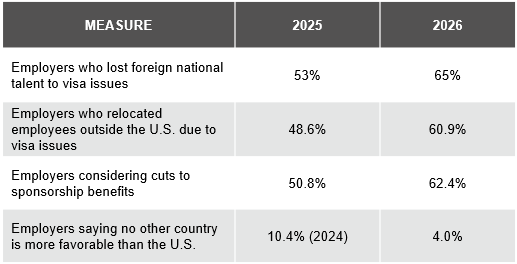
Other findings worth noting:
- 68% expect to use nearshoring or offshoring in 2026 to work around immigration barriers and U.S. labor shortages.
- 83.2% say USCIS or consular delays have moderately or significantly affected operations.
- 81% report that Requests for Evidence have increased over the past four years, with the sharpest increases at larger programs.
- 75% now begin green card sponsorship within the first three months of employment.
- 82% use premium processing, with H-1B processing times averaging roughly 10 to 11 months.
- The average immigration oversight team has grown from 4 people in 2024 to 6 in 2026, and 77.6% of organizations house immigration within HR.
- 54% are considering switching immigration providers, and 83% would prefer a single provider for U.S. and global immigration.
The pain is not evenly distributed. Larger programs, especially those with heavy H-1B and OPT populations, report the highest rates of talent loss (up to 76.5%) and relocation (up to 75.3%). Healthcare is the hardest-hit sector, with 51.2% saying visa processing has become more difficult since 2025.
The New Immigration Hiring Equation
Merlin Peter, writing from the talent acquisition side in The New Immigration Hiring Equation - Rethinking Global Talent in 2026 and 2027, reads the same Envoy data and reaches a clear conclusion: companies are not walking away from global talent, they are changing how and where they access it. In her words, immigration is becoming "part of the hiring decision itself."
She points to USCIS data showing how selective the H-1B system has become. Registrations for the FY2027 cap fell 38.5%, to 211,600. Of those selected, 71.5% held a U.S. advanced degree, up from 57% the year before, and about 46% were tied to the two highest prevailing wage levels. The system now favors senior, well-paid roles that are easy to justify as critical.
Her answer is a new equation. Rather than open a role, find a person and hand the paperwork to legal, employers should start with the capability they need. Then they weigh talent availability, work authorization, skill scarcity, location, cost, time to productivity and multi-year retention value. Sometimes the right answer is moving the work rather than the person, through nearshore hubs in Canada and Latin America or global capability centers in India, which now host more than 2,100 centers and about 2.36 million professionals.
That reframing matters for global mobility. If location becomes a variable in the hiring decision, mobility has to be at the table when that decision is made, not after. And with green card backlogs stretching past a decade for some nationalities (EB-2 India final action dates sit at November 2013 in the October 2026 Visa Bulletin), immigration roadmaps and long-term retention plans have to be built together.
Top 5 Takeaways for Global Mobility Programs
1. Outbound relocation is now an immigration contingency plan
Six in ten employers moved employees out of the U.S. because of visa problems in the past year, up from fewer than half in 2025. The top destinations are the U.K. (70%), Canada (61%) and Mexico (57%), followed by Australia and Germany.
These are not traditional assignments. They are often unplanned moves to keep a valued employee working. Mobility programs need a ready policy for them: who qualifies, whether the move is an assignment or a permanent transfer, and how tax, payroll and family support are handled. Building that playbook before the next denial is far cheaper than improvising after it.
2. Talent loss is a mobility problem, not just an immigration one
65% of employers lost foreign national employees to visa issues this year, and the rate climbs to 76.5% for H-1B-heavy employers. When an employee cannot return to the U.S. on schedule, most employers now choose paid leave to bridge the gap rather than lose the person.
Mobility teams sit at the center of this. Travel risk protocols, reentry contingency plans and clear employee communication are now retention tools. The employees most at risk are often the ones a company has already invested the most to recruit and move.
3. Benefit cuts are coming — make them deliberate
62.4% of employers are considering cutting at least one sponsorship benefit. Dependent fees (70.4%) and premium processing (69.4%) top the list, and more than half are questioning green card cost coverage.
The risk is that cuts happen piecemeal, line by line, without anyone looking at the full employee experience. Before trimming, programs should model the total cost of a sponsored employee, including the cost of losing them. The report's own authors note that the cost of sponsorship is often outweighed by the cost of attrition.
4. Build longer immigration timelines into every move
83.2% of employers say processing delays have disrupted operations. H-1B processing averages roughly 10 to 11 months, and PERM runs 16 to 18 months. In response, 75% of employers now start green card sponsorship within three months of hire.
For mobility, this changes the planning calendar. Start dates, temporary housing, home sale timing and family moves all depend on work authorization landing on time. Relocation and immigration timelines need to be built together from day one, with realistic buffers.
5. Immigration and relocation are converging
Immigration teams have grown from 4 to 6 people in two years, and HR now owns immigration at 77.6% of organizations. 54% of employers are considering a provider switch, driven mostly by service quality rather than cost. And 83% would prefer a single provider for U.S. and global immigration.
The broader signal is that employers want fewer handoffs and more coordination. Immigration, relocation, tax and payroll touch the same employee at the same moment. Programs that connect those workstreams, through shared timelines, shared data and partners who talk to each other, will move faster and lose fewer people.
The Bottom Line
The U.S. immigration system has become slower, costlier and less predictable, and employers are responding by moving people, not just filing paperwork. That puts global mobility squarely in the middle of the response.
The programs that come out ahead will treat immigration constraints as a planning input, not a surprise. They will have outbound playbooks ready, timelines that reflect reality and benefit decisions grounded in the true cost of losing talent.