The long-term assignment isn't going anywhere, but the way companies deliver it is quietly changing. In Plus Relocation's 2026 Global Mobility Trends & Insights survey, 88% of mobility leaders expected international LTA volume to hold steady or increase this year, with most (72%) expecting it to hold. AIRINC's 2026 Policy & Practice Benchmark: Long-Term Assignments shows organizations keeping the core LTA model intact while tightening how they fund, flex, and deliver the benefits around it.
We wanted to see how those findings stack up against what we observe day to day. So we set them alongside Plus Relocation's own international LTA policy benchmark, which covers 40+ client companies across technology, manufacturing, energy, and financial services. The short version: the two data sets tell a consistent story, and together they surface a gap neither one shows on its own.
What's changed: more structure, more cash, more intention
The clearest theme in AIRINC's data is a move away from ad hoc decisions toward defined frameworks.
- Flexibility is becoming a program feature, not an exception. Only 23% of companies now grant business flexibility by exception, down from 33% in 2022. The share with no employee flexibility mechanism at all fell from 45% to 29%, and lump sums or cash allowances are now used by 49% of companies (up from 37%).
- Cash is replacing in-kind support. 55% now pay the miscellaneous relocation allowance as a flat amount rather than a percentage of salary (43% in 2022). And 41% deliver shipping through a cash allowance or default cash payment.
- Housing is more tailored, and less shared. 35% now blend housing standards by job level or location (23% in 2022). Meanwhile, 80% no longer deduct a housing norm or ask employees to contribute, up from 61%.
- Families are getting more support, with guardrails. Partner assistance is offered always or sometimes by 75% of companies (63% in 2022). At the same time, education benefits are seeing more caps: only 53% leave them uncapped, down from 64%.
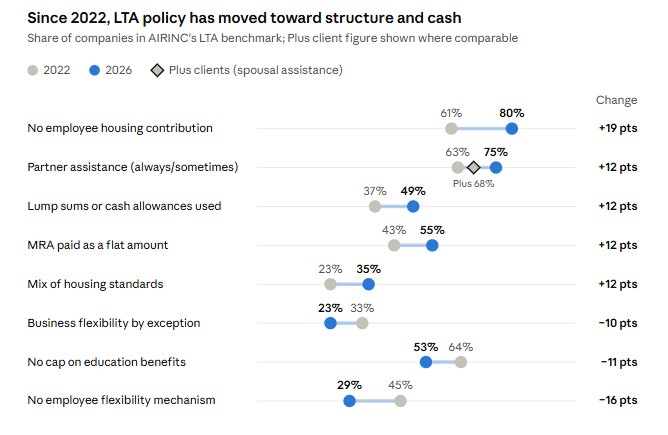
Every shift points the same direction: fewer open-ended commitments, more defined choices.
Our own survey points the same way. In the 2026 Global Mobility Trends & Insights report, the top reasons programs gave for revising policies were improving the employee experience (54%) and adding flexibility (46%). Cost reduction through benefit caps (20%) and benefit removal (17%) ranked well behind. Companies are tightening how benefits are delivered, but not by defaulting to cuts.
What's stayed the same: the core LTA model
Underneath those shifts, the architecture of the LTA is remarkably stable. Assignments still most commonly start at 12 months (65% in 2026 vs. 68% in 2022), with maximums typically set at three years (38%) or five years (39%). Tax-equalized, home-based programs remain the standard for more than 75% of companies.
Cost of living adjustment administration is steady too, with semi-annual (36%) or annual (32%) updates and 57% monitoring exchange rates in between. Home leave is still typically once a year for accompanied assignments, most often via company-booked airfare (38%) or cash (31%). Hardship premium caps are inching up, now used by 43% of companies (37% in 2022), with the average salary cap holding near USD 191,000.
Where our client data lines up
On the fundamentals, our portfolio looks a lot like AIRINC's market.
- Tax equalization is the norm. 75% of our benchmark companies use tax equalization, closely matching AIRINC's "over 75%" for tax-equalized, home-based programs.
- Partner support is mainstream. 68% of our client benchmark companies offer spousal assistance. AIRINC's 75% counts companies that provide it "sometimes," which likely explains much of the gap.
- Family and living support is near-universal. Host housing, home leave, and dependent education are each offered by 95% of our clients. That fits AIRINC's picture of education and home leave as standard benefits now being managed more tightly, not cut.
- The "getting there" foundation is fixed. En route travel, destination services, immigration assistance, and full household goods shipment are offered by all benchmark companies. These are table stakes for any international LTA.
Where our view adds something different
The two benchmarks measure different things. AIRINC focuses on how benefits are structured and delivered. Our benchmark tracks whether a benefit is offered at all. Read together, they sharpen each other.
Offered isn't the same as delivered in-kind. Every one of our clients offers full household goods shipment, and 95% offer a miscellaneous or settling-in allowance. AIRINC's data suggests the question is no longer whether these are provided, but how: more as flat amounts and cash. The 62% of our clients offering a furniture allowance option fits that same trend toward choice.
COLA (cost of living adjustment) isn't universal. AIRINC reports on how often COLAs are updated. Our data adds that only 71% of clients offer a COLA at all, so nearly three in ten are already leaning on other ways to protect purchasing power.
Hardship support is targeted. AIRINC finds more companies capping hardship premiums. Our data shows how selective the benefit already is: only 48% of our clients offer a hardship allowance at all, and just 24% offer emergency assistance, reflecting where clients actually send people.
What this means for your LTA program
- Keep the core, refine the delivery. The structure of the LTA is settled. The opportunity is in how benefits are delivered: flat amounts, lump sums, and defined flexibility tend to be easier to administer and easier for assignees to understand.
- Replace exceptions with a framework. If exception requests are a recurring headache, a tiered or core/flex model is where the market is heading.
- Revisit family benefits with intention. Partner support is expanding while education costs are being capped. Make sure both reflect who you're actually sending.
- Match premiums to locations. Hardship and emergency support are increasingly targeted. Reserve them for the assignments and locations where they make a real difference.